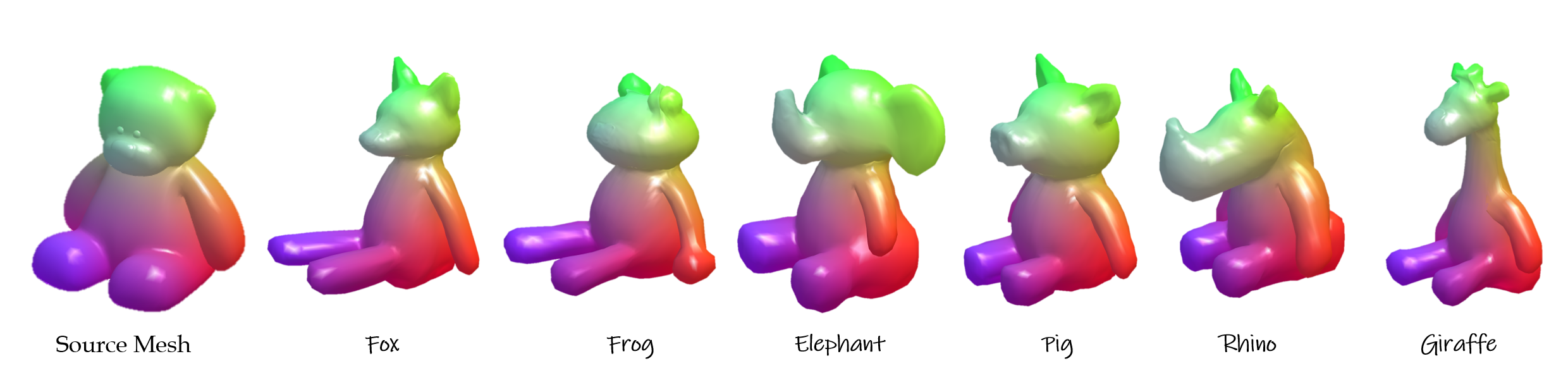
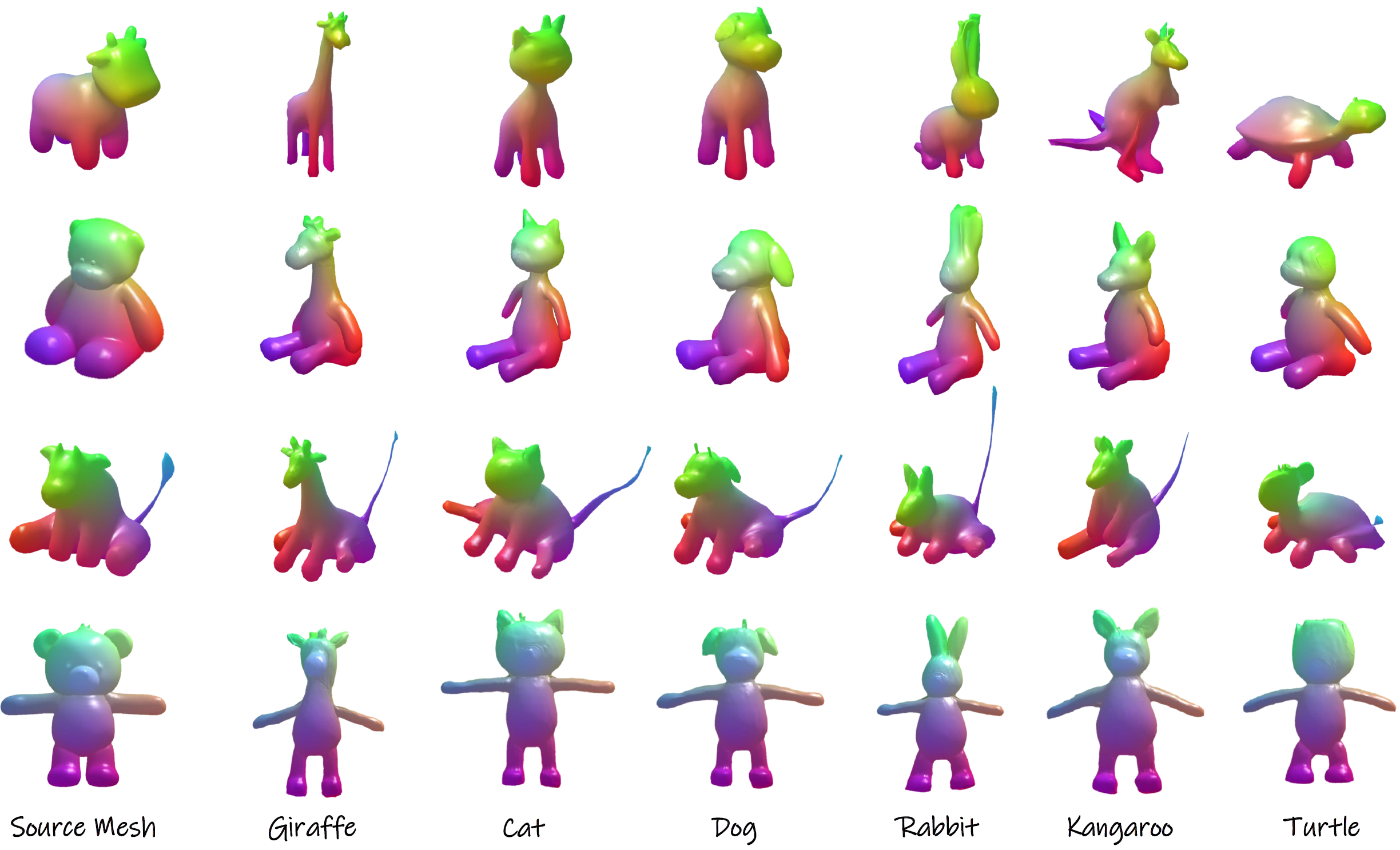
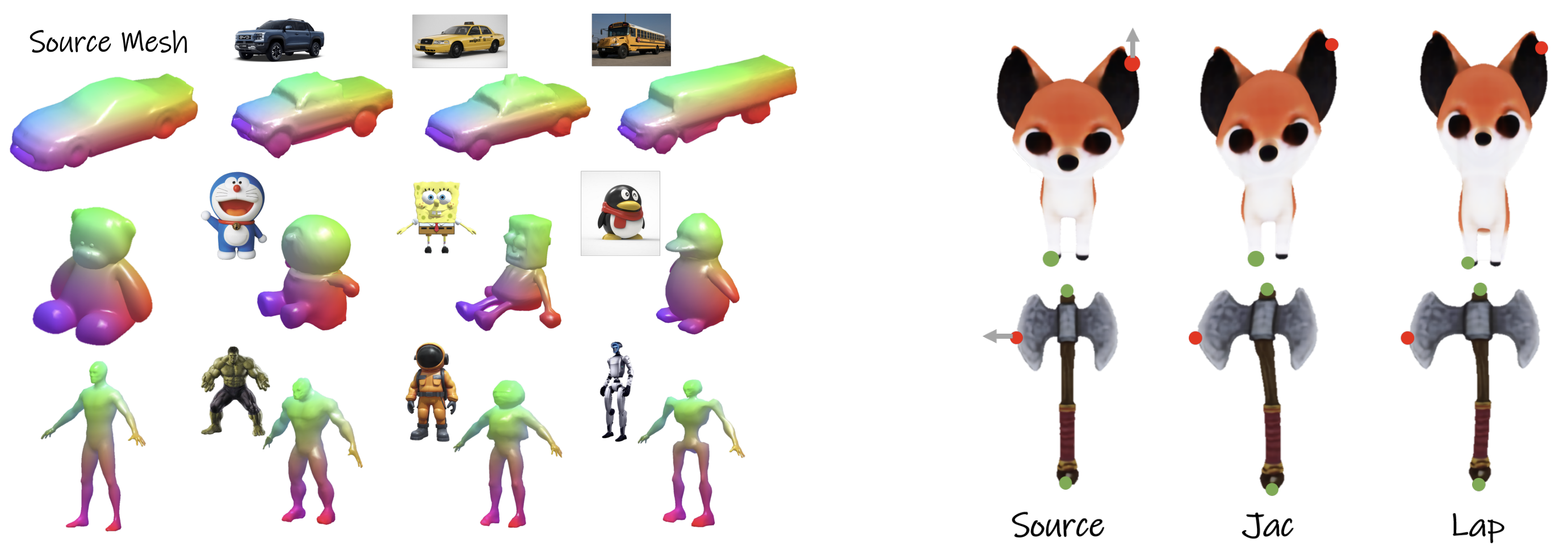
Mesh deformation, the process of altering the vertex positions of a 3D mesh while preserving its topological structure, is a cornerstone of computer graphics. Despite the recent emergence of numerous textguided 3D mesh deformation methods, deforming an initial mesh into one that both adheres to text prompts and preserves its pose remains challenging. This paper proposes PoseAlign, which decomposes text-guided mesh deformation into two stages: global pose scaling and local detail sculpting. Specifically, in the first stage, we introduce the Laplacian as a differentiable mesh representation to enable more efficient yet smoother global deformation. Then, we propose a novel pose-aligned SDS loss by adapting score distillation sampling (SDS) with an attention-sharing mechanism, which sculptures fine-grained geometric details for the deformed mesh while preserving its original pose. PoseAlign significantly enhances the controllability of the overall deformation process, achieving a favorable balance between pose preservation and text alignment. Experiments demonstrate the competitive advantages of our method in text alignment and mesh quality.
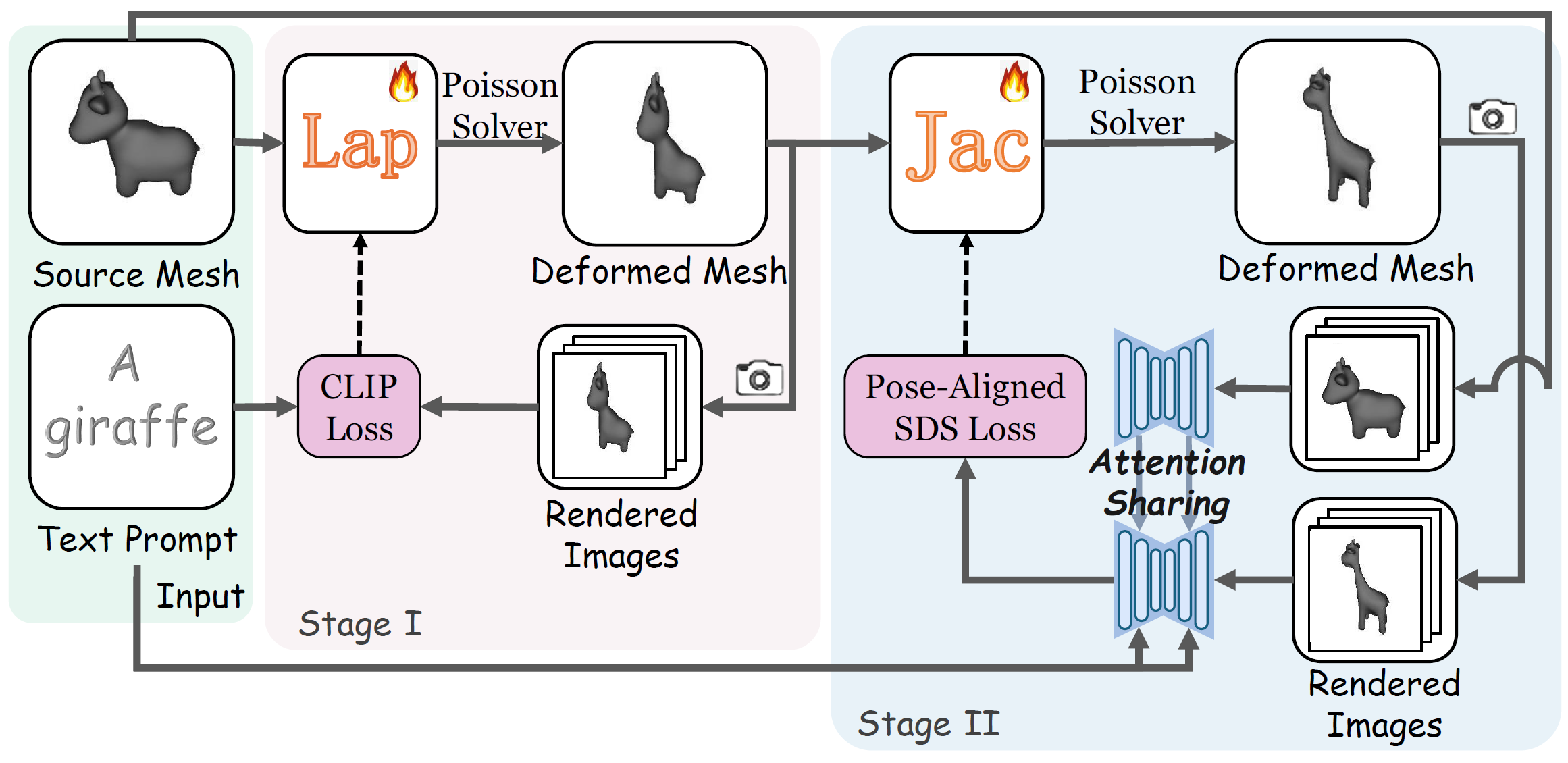
We decompose the mesh deformation process into two stages: Global Pose Scaling and Local Detail Sculpting. The first stage optimizes the Laplacians to generate a deformed mesh via Poisson solver, followed by differentiable rendering to produce rendered images. These images are then evaluated against the text prompt using the CLIP loss. The second stage leverages the Jacobians to further optimize the fine details of the deformed mesh from Stage I. Using the Poisson solver and differentiable rendering again, the updated mesh is supervised by the Pose-Align SDS loss, with the attention sharing mechanism incorporated to ensure coherent geometric and textural details.
@misc{wang2026posealign,
  title={PoseAlign: Sculpting Pose-Consistent Meshes via Text-Guided Deformations},
  author={Shijin Wang and Zichong Chen and Yang Zhou and Hui Huang},
  year={2026},
  eprint={2607.10560},
  archivePrefix={arXiv},
  primaryClass={cs.CV},
  url={https://arxiv.org/abs/2607.10560},
}